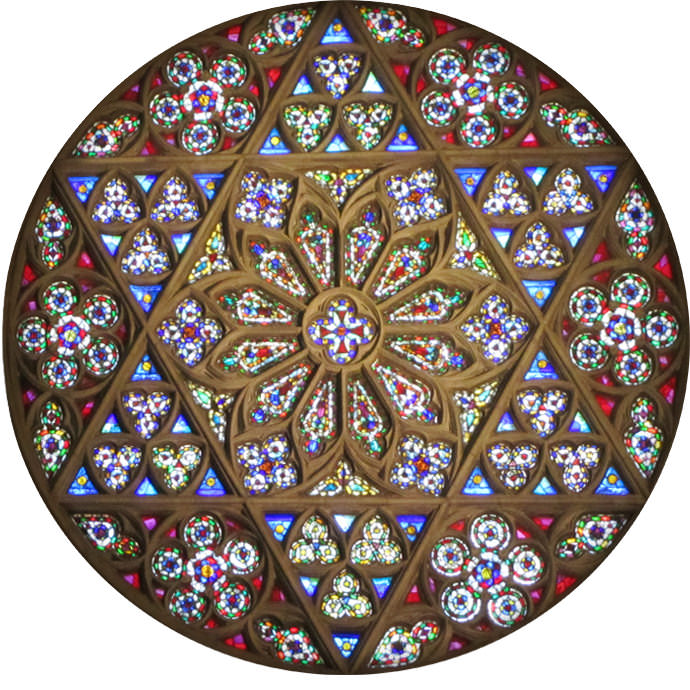
Design your own Gothic Rose Window
1. A Picture of Heaven
Rose windows were meant to show what heaven might look like: colorful, bright, balanced, and perfect.
When sunlight passes through the glass, it creates a rainbow glow inside the church, reminding people of the beauty and mystery of the divine.
2. The Circle = Eternity
The round shape isn’t random.
In medieval symbolism:
A circle means eternity — something that has no beginning and no end.
It represents God, who is eternal, and the idea that divine love never stops.
So the shape itself was a spiritual message.
3. A Story in Colors
Before people could read, stained-glass windows were like comic books made of light.
Rose windows often showed:
- scenes from the Bible
- saints and their stories
- symbols for virtues (like courage, kindness, wisdom)
The light shining through them made the stories feel alive.
4. Light as a Symbol of God
Medieval Christians believed that light = God’s presence.
So when sunlight shone through the rose window and filled the church interior, it felt like a sign that God was entering the space.
The idea was:
When light passes through the window, God’s love passes into the world.
5. Colors With Meaning
Colors were chosen carefully, not randomly.
Common meanings:
- Blue → heaven, peace
- Red → love, sacrifice
- Green → life, hope
- Gold → divine light
- Purple → royalty or holiness
The window was basically a giant spiritual mood board.
6. A Map of the Universe
Some rose windows are arranged like a cosmic map:
- The center = God or Christ
- The rings = angels, saints, or the order of creation
- The outer shapes = the world of humans
It’s like looking at a symbolic diagram of the entire universe.
7. A Feeling, Not Just a Symbol
Ultimately, rose windows were designed to make people feel something:
wonder, peace, joy, or a sense of the sacred.
Even today, when you stand in front of one, the glow of the colors creates an atmosphere that feels almost magical.
Objective
- Understand the aesthetic and symbolic importance of rose windows in Gothic cathedrals.
- Experiment with symmetry, color, and simple geometric shapes.
- Develop creativity through an accessible and playful approach.
Materials
- A sheet of paper or white cardstock.
- A plate or large compass (to draw the main circle).
- A ruler.
- Markers, crayons, or watercolors.
- (Optional) Circular or geometric shape templates.
Steps
Draw the base:
- Using a plate or compass, draw a large circle in the center of the page.
- Mark a small circle in the center (the “eye” of the rose window).
Simple division:
- Divide the circle as if it were a pizza (4, 6, or 8 parts).
- It doesn’t need to be perfect—just symmetrical enough.
Design the rose window:
- In each section, draw a repeated geometric shape (triangles, circles, teardrops, petals).
- Remember that all parts should look similar, like a mandala.
Decoration and color:
- Fill in with bright colors that resemble stained glass (blues, reds, yellows).
- Trace the edges with a black marker so they look like the lead in stained-glass windows.
Final touch:
- Add details between the sections (little flowers, stars, crosses, invented motifs).
Duration
- 2 sessions (1 for drawing and structure, 1 for color and finishing touches).
Evaluation criteria
- Use of basic symmetry and repetition of shapes.
- Creativity in decorative motifs.
- Expressiveness in color choices.
- Care in finishing (outlines, filling, contrast).