“I Learn and Use the Six Colors”
🎨 ACTIVITY: “I Learn and Use the Six Colors”
📚 EPVA Curriculum Content (Art, Visual and Audiovisual Education)
- Identification of primary and secondary colors
- Expressive use of color
- Basic color mixing
- Creativity and neatness in artwork
🎯 Objectives
- Identify the six basic colors
- Understand how secondary colors are created
- Apply color in an organized and creative way
✏️ Materials
- Pencil and eraser
- Ruler
- Markers or poster paints (red, yellow, and blue)
- White sheet of paper or Art notebook
🖍️ Activity Instructions
Part 1 – Identification (10 min)
- Draw 6 circles of the same size.
- Write the name of a color under each one:
- Red
- Yellow
- Blue
- Green
- Orange
- Violet (Purple)
- Color each circle correctly.
Part 2 – Color Mixing (10 min)
Answer and draw:
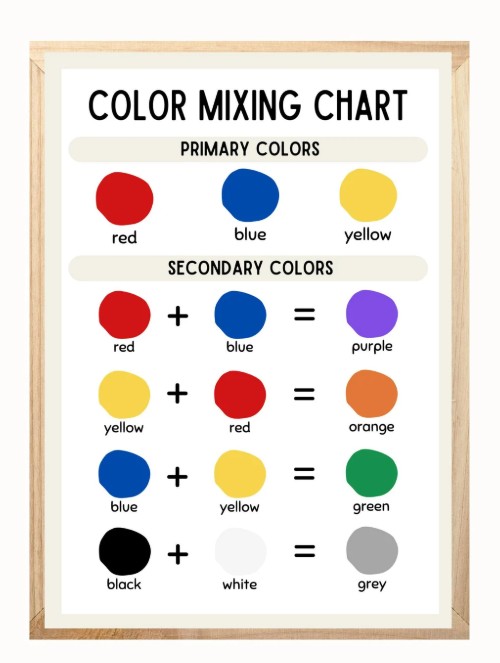
- Red + Yellow = __________
- Yellow + Blue = __________
- Blue + Red = __________
Color small circles with the result of each mix.
Part 3 – Creative Application (20 min)
Draw one of the following themes (choose only one):
- A landscape
- An imaginary animal
- A room
- A robot
🔹 Rules:
- You must use all six colors
- You cannot repeat the same color in two adjacent areas
- The drawing must be neat and well colored
✅ Assessment Criteria
- Correct identification of colors (2 points)
- Correct color mixing (2 points)
- Use of all six colors (2 points)
- Creativity and composition (2 points)
- Neatness and presentation (2 points)
Total: 10 points
⭐ Extension Activity (Optional)
Invent a name or feeling for each color
(e.g., red = “energy”, blue = “calm”).
If you want, I can also adapt it for:
- students with special educational needs
- printable worksheet format
- digital version (tablets / Google Classroom)
«Warm colors (yellow, orange, red, and their derivatives such as browns and golds) evoke energy, sun, and fire, while cool colors (blue, green, violet, and their variations) convey calmness and freshness, and are associated with water or winter. This divides the color wheel into two main groups, although some tones—such as certain greens or grays—can be warm or cool depending on their predominant undertones (yellow or blue).»
Key Vocabulary Breakdown
- Warm colors: Colores cálidos
- Cool colors: Colores fríos
- Color wheel: Círculo cromático
- Undertones/Nuances: Matices
- To evoke: Evocar
How do we make tertiary colours?
How do we make tertiary colours?
Tertiary colours are made by mixing one primary colour with one secondary colour.
🟥 Primary colours
- Red
- Blue
- Yellow
🟧 Secondary colours (primary + primary)
- Red + Yellow = Orange
- Blue + Yellow = Green
- Red + Blue = Purple
🎨 Making tertiary colours
Mix a primary colour with a secondary colour next to it on the colour wheel:
- Yellow + Green = Yellow-green
- Blue + Green = Blue-green
- Blue + Purple = Blue-purple
- Red + Purple = Red-purple
- Red + Orange = Red-orange
- Yellow + Orange = Yellow-orange
👉 Important rule:
Only mix neighbour colours on the colour wheel.
🧠 Key idea (student-friendly)
Tertiary colours are between primary and secondary colours.