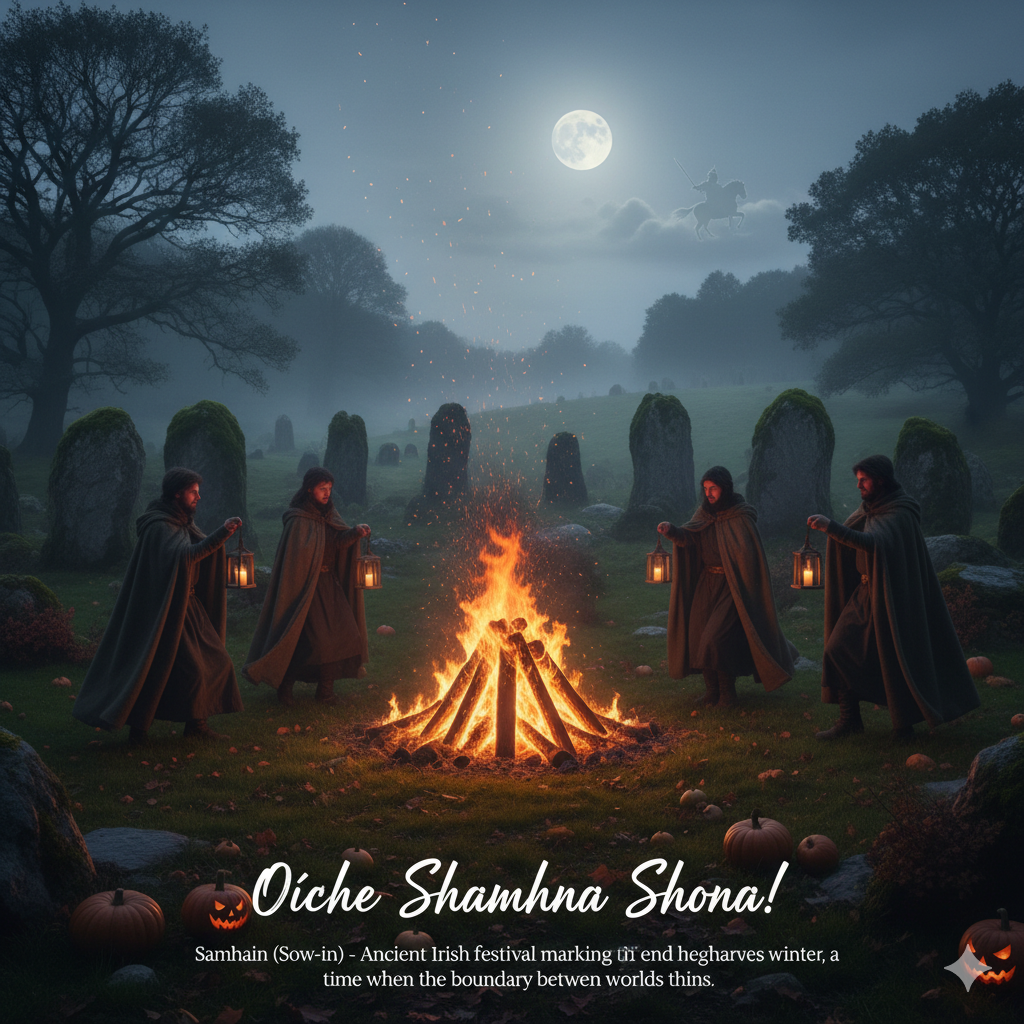
Samhain
Samhain (pronunciado «Sow-in») es una festividad gaélica que se celebra tradicionalmente la noche del 31 de octubre al 1 de noviembre. Es una de las cuatro festividades gaélicas antiguas que marcan las estaciones, y es especialmente significativa porque marca el final de la temporada de la cosecha y el comienzo del invierno o la «mitad oscura» del año.
Históricamente, Samhain era un tiempo crucial en el calendario celta. Se creía que durante esta noche, el velo entre nuestro mundo y el «Otro Mundo» (el reino de los espíritus y las hadas) era más delgado, permitiendo que las almas de los muertos regresaran a sus hogares y que otras criaturas místicas se manifestaran.
Para los celtas, Samhain implicaba varias prácticas:
- Hogueras: Se encendían grandes hogueras comunales. Se creía que estas hogueras tenían poderes protectores y purificadores, y se usaban para honrar a los ancestros y ahuyentar a los malos espíritus. A menudo, el ganado se conducía entre dos hogueras para protegerlo.
- Ofrendas: Se dejaban ofrendas de comida y bebida para los espíritus ancestrales y las deidades.
- Disfraces: La gente se disfrazaba (a menudo con pieles de animales o ropas que ocultaban su identidad) para parecerse a los espíritus o para confundirlos y evitar ser reconocidos por ellos. Esta es una de las raíces de la tradición moderna de los disfraces de Halloween.
- Adivinación: Era un tiempo propicio para la adivinación sobre el futuro.
- Banquete: Se celebraban grandes banquetes, con la esperanza de que los espíritus de los seres queridos se unieran a ellos.
Con la llegada del cristianismo, muchas de las tradiciones de Samhain se mezclaron con las celebraciones cristianas del Día de Todos los Santos (1 de noviembre) y el Día de Todas las Almas (2 de noviembre). Así, Samhain es considerado el precursor de lo que hoy conocemos como Halloween. En Irlanda, todavía se celebra con un fuerte sentido de su herencia celta, y es una época llena de historias, hogueras y, por supuesto, diversión.
Samhain (pronounced «Sow-in») is a Gaelic festival traditionally celebrated on the night of October 31st leading into November 1st. It is one of the four ancient Gaelic seasonal festivals, and it is particularly significant because it marks the end of the harvest season and the beginning of winter or the «darker half» of the year.
Historically, Samhain was a crucial time in the Celtic calendar. It was believed that on this night, the veil between our world and the «Otherworld» (the realm of spirits and fairies) was thinnest, allowing the souls of the dead to return to their homes and other mystical creatures to manifest.
For the Celts, Samhain involved several practices:
- Bonfires (Hogueras): Large communal bonfires were lit. These fires were believed to have protective and purifying powers and were used to honor ancestors and ward off evil spirits. Cattle were often driven between two bonfires for protection.
- Offerings (Ofrendas): Offerings of food and drink were left for ancestral spirits and deities.
- Disguises (Disfraces): People would disguise themselves (often in animal hides or clothes that concealed their identity) to look like spirits or to confuse them and avoid being recognized by them. This is one of the roots of the modern tradition of Halloween costumes.
- Divination (Adivinación): It was a favorable time for fortune-telling about the future.
- Feasting (Banquete): Large feasts were held, with the hope that the spirits of loved ones would join them.
With the arrival of Christianity, many of the traditions of Samhain merged with the Christian celebrations of All Saints’ Day (November 1st) and All Souls’ Day (November 2nd). Thus, Samhain is considered the precursor to what we now know as Halloween. In Ireland, it is still celebrated with a strong sense of its Celtic heritage, and it is a time full of stories, bonfires, and, of course,