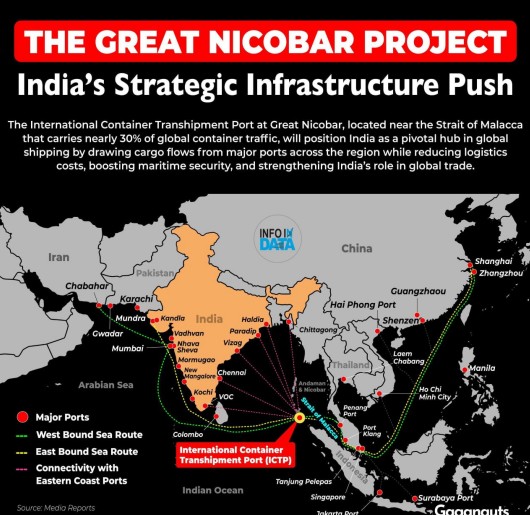
The Great Nicobar Project
Great Nicobar Project is making WAVES
India’s green court (NGT) has refused to “interfere” with the 2022 environmental clearance for the Great Nicobar mega-project, explicitly noting its strategic importance (https://t.me/geo_gaganauts/12512) and saying the approvals carry adequate safeguards — meaning the biggest legal obstacle has just been cleared. Now the real build-out accelerates.
International transshipment port: Galathea Bay
This is the headline asset — designed to pull India’s container transshipment traffic back home instead of routing it through regional hubs.
Why Galathea Bay works:
Extremely deep natural waters (over ~20m), ideal for the newest mega container ships.
Near the main East-West shipping artery, close to the Strait of Malacca — one of the world’s busiest maritime corridors
Scale (this is not a “small port”):
Phase 1–2: $5.3 billion USD investment, targeting ~11 million twenty-foot equivalent units (TEU) capacity.
Ultimate plan: expansion to ~16.2 million TEUs.
Tenders are expected under a PPP / landlord-style model (public port authority + private operations), built in phases.
Reporting indicates the plan is structured to keep the terminal operator Indian-controlled (majority Indian stake), treating it as a national strategic node, not just another «commercial concession.”
The airport: a Code-F runway capable of A380-class operations
The Great Nicobar greenfield airport isn’t a vanity project — it’s the connective tissue for the entire hub.
The Airports Authority of India has moved into groundwork tenders (marine geotechnical investigations, project management consultancy), with the airport package cited at ~$1.03 billion USD in tender documents.