Parallels and Meridians: Finding Your Way on Earth
To find any exact location on Earth, we use an imaginary grid of lines called parallels and meridians. These lines give us geographical coordinates. Degrees, minutes, and seconds (DMS) are used to describe exact locations on Earth. A degree (°) is divided into 60 minutes (′), and each minute into 60 seconds (″). This system helps make coordinates more precise, so we can find places more accurately on maps or GPS.
1. Parallels and Latitude
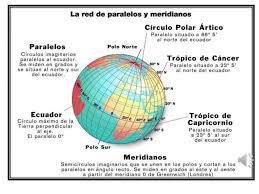
Parallels are imaginary circles that run east-to-west around the Earth.
- The Equator : The main parallel. It divides the Earth into the Northern Hemisphere and the Southern Hemisphere.
- Latitude: The distance north or south of the Equator.
- Important Parallels: * Arctic and Antarctic Circles.
- Tropic of Cancer and Tropic of Capricorn.
2. Meridians and Longitude
Meridians are imaginary lines that run north-to-south from the North Pole to the South Pole.
- Greenwich Meridian The starting point for measuring east and west. It divides the Earth into the Eastern Hemisphere and the Western Hemisphere.
- Longitude: The distance east or west of the Greenwich Meridian. There are 360 meridians in total.
3. Climate Zones
Because Earth is a sphere, the Sun’s rays hit different parts of the planet at different angles, creating three main temperature zones:
- Hot (Torrid) Zone: Located between the two Tropics. The Sun hits directly, making it the hottest area.
- Temperate Zones: Located between the Tropics and the Polar Circles. These areas have four distinct seasons.
- Cold (Frigid) Zones: Located inside the Arctic and Antarctic Circles. The Sun’s rays are very weak here, so it is always cold.
4. Coordinates: How to Pinpoint a Place
To find a city on a map, you need two numbers:
- Latitude: Is it North (N) or South (S) of the Equator?
- Longitude: Is it East (E) or West (W) of the Greenwich Meridian?
9. What’s the significance of the following?
a. 365 days and 6 hours
This is the time the Earth takes to complete one orbit around the Sun (one year). The extra 6 hours are why we have a leap year every 4 years.b. 29.5 days
This is the time it takes for the Moon to complete one full cycle of phases (a lunar month).c. 21–22 December
This is the winter solstice in the Northern Hemisphere — the shortest day and longest night of the year.d. 7.4 days
This is roughly the time between each main phase of the Moon (e.g., new moon → first quarter → full moon → last quarter).
10. How the Moon’s gravitational pull causes tides (summary)
The Moon’s gravity pulls on the Earth’s oceans, causing water to bulge out on the side closest to the Moon. Another bulge forms on the opposite side due to inertia. These bulges create high tides, while areas in between experience low tides. As the Earth rotates, different places move through these bulges, causing regular tides.
11. Leap year question
- The last leap year was 2024
- The next leap year will be 2028
People born on 29 February usually celebrate their birthday on 28 February or 1 March in non-leap years.
12. Do all parts of the world experience four seasons?
No, not all parts of the world experience four seasons.
- Tropical regions (near the Equator) usually have two seasons: wet and dry.
- Polar regions mainly have summer and winter (extreme light and dark periods).
- Four distinct seasons (spring, summer, autumn, winter) mainly occur in temperate regions.
13. Podcast questions
a. How long does it take the Moon to orbit the Earth?
About 27.3 days (orbit), or 29.5 days including phases.b. How much wider is the Sun than the Moon?
The Sun is about 400 times wider than the Moon.c. Why do the Sun and the Moon appear to be a similar size?
Because the Sun is much larger but also much farther away (about 400 times farther), making them appear similar in size from Earth.
This isthe link: Parallels and meridians, latitude and longitude
https://wordwall.net/es/resource/5723207/science/parallels-and-meridians-latitude-and-longitude